
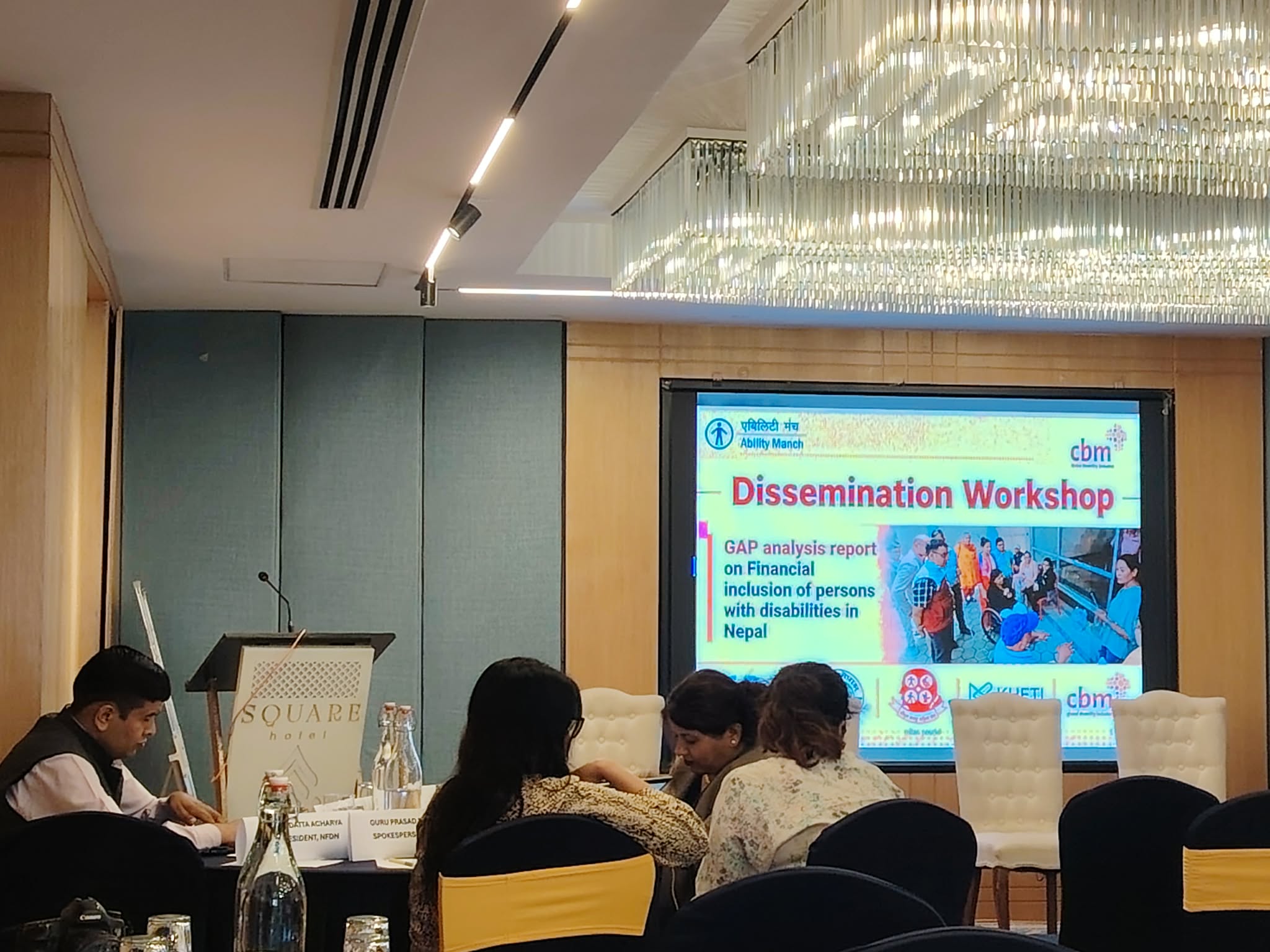
24 July 2026 – Government representatives, financial institutions, organisations of persons with disabilities (OPDs), development partners, and accessibility experts gathered in Lalitpur on Friday for the Dissemination Workshop on the GAP Analysis: Financial Inclusion of Persons with Disabilities in Nepal, calling for urgent action to make Nepal’s financial sector more inclusive and accessible for persons with disabilities.
The workshop was organised under the Financial Autonomy and Inclusion of Persons with Disabilities through Agriculture (FAIDA) Project. The event served as a platform to present key findings from the GAP Analysis report and facilitate dialogue among policymakers, financial service providers, disability rights organisations, and development partners on addressing barriers to financial inclusion.
The programme began with opening remarks outlining the objectives of the workshop, followed by powerful testimonies from persons with disabilities who shared their lived experiences in accessing financial services.
Chiranjiwi Poudel, representing Seeing Hands and a person with blindness, Sanchala Niraula, a business owner with a physical disability, and Ranjit Das, a Deaf coffee shop owner, highlighted the challenges they have faced in accessing banking services, loans, digital financial platforms, and entrepreneurship opportunities. Their experiences underscored the need for accessible banking systems, inclusive policies, and disability-sensitive financial services.
The workshop featured the presentation of the GAP Analysis Report: Financial Inclusion of Persons with Disabilities in Nepal, delivered by Vishwo Ram Shrestha and experts from Ability Manch. The report examined existing gaps in Nepal’s financial sector and presented recommendations to improve access to banking, savings, credit, insurance, digital finance, and other financial services for persons with disabilities.
An interactive question-and-answer session allowed participants to engage with the report’s findings before a panel discussion on “Making Nepal’s Financial Sector Inclusive and Accessible.”
The panel included:
- Khom Raj Sharma, Accessibility Expert
- Guru Prasad Paudel, Spokesperson, Nepal Rastra Bank
- Kapil Gautam, Senior Officer, Nepal Bankers’ Association
- Devi Datta Acharya, President, National Federation of the Disabled Nepal (NFDN)
- Sarita Lamichhane, Digital Accessibility Expert
Panelists emphasised the importance of strengthening disability-inclusive financial policies, improving physical and digital accessibility of financial institutions, promoting financial literacy, and expanding access to affordable financial products and services for persons with disabilities. They also stressed the need for stronger collaboration among the government, regulators, banks, cooperatives, OPDs, and development partners to ensure equal financial opportunities for all.
The event concluded with an open discussion, allowing participants to share feedback and recommendations, followed by closing remarks delivered by Khom Raj Sharma and Rajan Bhattarai, Country Director of CBM Global Nepal.
The workshop was organised under the FAIDA (Financial Autonomy and Inclusion of Persons with Disabilities through Agriculture) Project, a four-year initiative running from 2024 to 2028. Funded by Jersey Overseas Aid (JOA), managed by CBM UK, and implemented by CBM Global Nepal in partnership with SAPPROS Nepal, National Disabled Women Association (NDWA), and KHETI Farm, the project is being implemented in Chitwan District.
The FAIDA Project aims to promote financial autonomy and economic empowerment of persons with disabilities by improving access to financial services, strengthening financial literacy and resilience, and supporting disability-inclusive, climate-smart agricultural livelihoods. The initiative is expected to directly benefit 15,000 persons with disabilities while indirectly reaching approximately 83,000 persons without disabilities, contributing to more inclusive economic development and helping break the cycle of poverty and disability.
Participants concluded that achieving meaningful financial inclusion requires coordinated efforts to eliminate physical, communication, digital, and policy barriers, ensuring that persons with disabilities can fully participate in Nepal’s financial system and broader economic development.
“Financial inclusion is not only about access to banking services—it is about ensuring equal opportunities, dignity, independence, and economic empowerment for persons with disabilities,” was a key message echoed throughout the workshop.